Why Nusa Penida Is Famous · The Three Things That Put It on Every Bali Itinerary
August 6, 2026 · Travel Guide
Dramatic cliffs, world-class diving, and a deep Hindu heritage. A short guide to what Nusa Penida actually is famous for, beyond the photos.
Nusa Penida has a visual identity that almost nothing else in Southeast Asia can match: sheer limestone cliffs dropping into turquoise water, white-sand coves accessed down carved cliff staircases, and a marine life that includes the world's largest ray and the world's heaviest bony fish. It has been on the map of every Bali traveller for less than a decade, but in that window it has become one of the most recognisable islands in the region. The fame breaks down into three things: the cliffs and the iconic viewpoints, the underwater life, and a quieter third string — the spiritual and cultural heritage you only see if you go looking for it.
Below is each of those in plain terms.
The cliffs and the iconic viewpoints
Four locations do most of the work. They are the same four you will see in every travel feed featuring Nusa Penida, in roughly the same order.
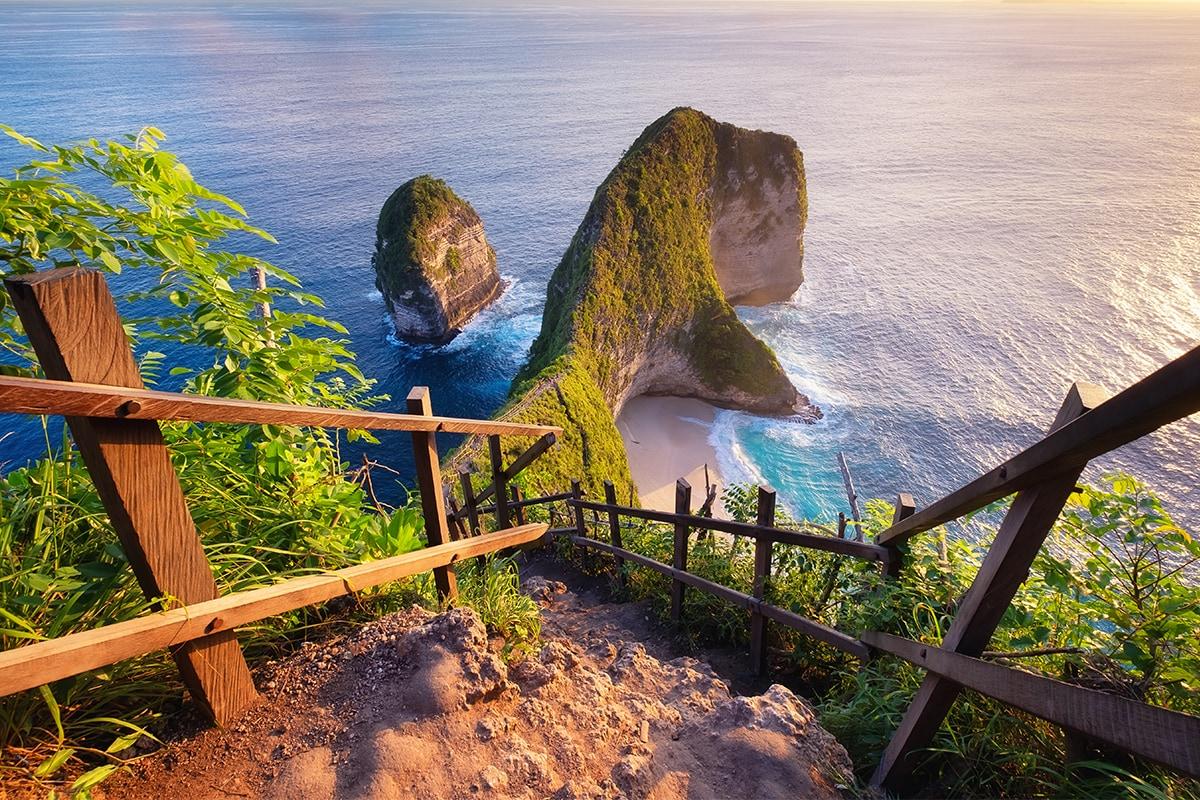
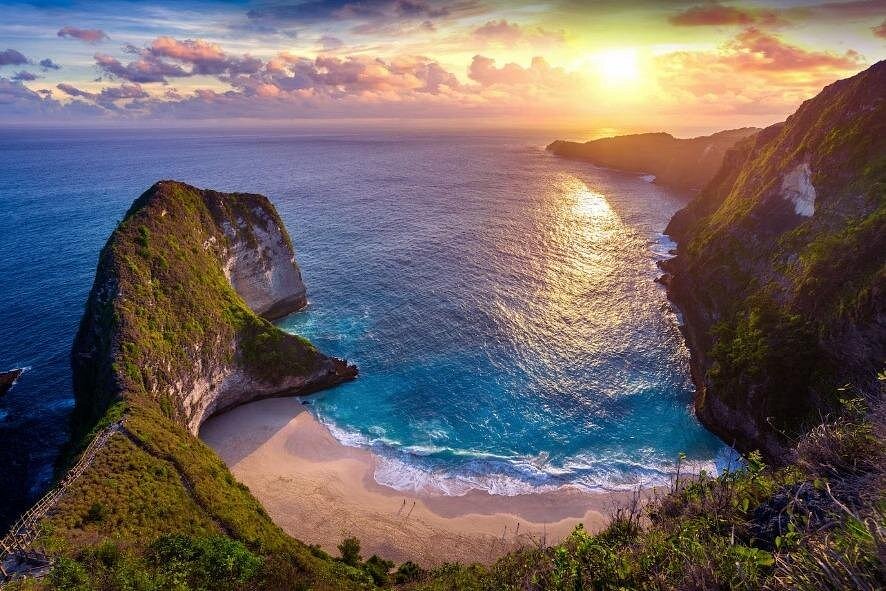
Kelingking Beach. The headline. A limestone headland shaped like a T-Rex from the clifftop platform, with a sliver of white sand hidden where the belly meets the cliffs. The view is what people come for; the descent is what comes with a warning. Most visitors stay on the platform and that is enough.
Broken Beach (Pasih Uug). A natural limestone arch wrapping around a circular cove — the collapsed roof of an ancient sea cave, with the Indian Ocean still rolling through the broken side. Viewpoint only; there is no beach access. The geology is the appeal.
Angel's Billabong. Two minutes' walk from Broken Beach along the cliff. A natural infinity pool carved into pale volcanic rock. Tide-dependent — calm and swimmable at low tide, dangerous at high tide and during freak waves outside the strict high-tide window. Aim for low tide and stay aware of the seaward edge.
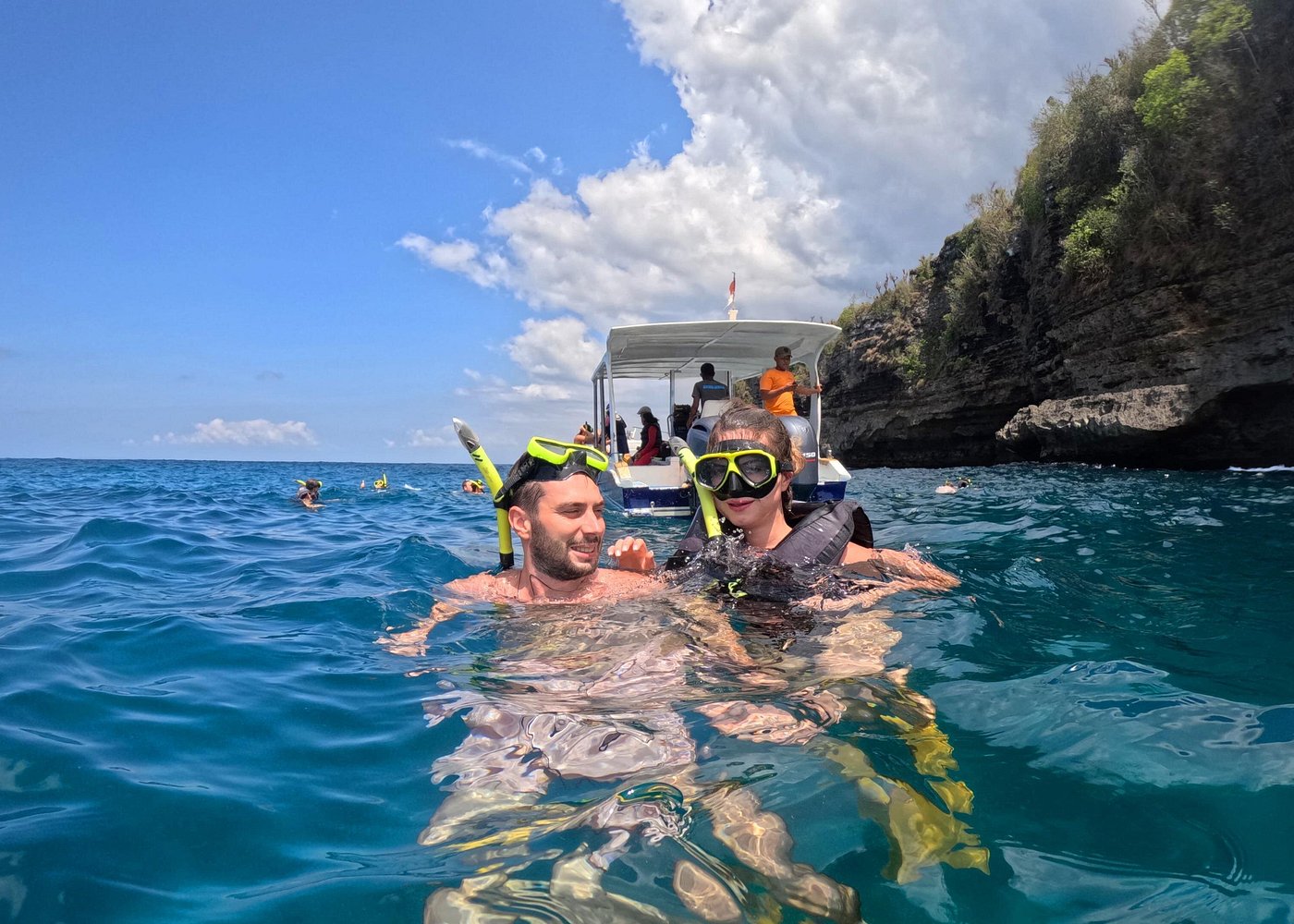
Crystal Bay. A wide horseshoe-shaped bay with white sand and a gently sloping bottom, fringed by reef on both sides. The clearest water on the west coast and the easiest snorkel on the island. Visibility regularly clears 20 metres, sun-warmed water year-round.
Together, those four are what most people mean when they say they have 'been to Nusa Penida'. They cluster within 20 minutes' drive of each other on the south-western side of the island, which is also where most of the resorts are based. The east coast is a longer drive but holds the quieter headline stops: Diamond Beach, Atuh Beach, Rumah Pohon, Raja Lima, and Suwehan — a separate set of beaches with their own staircase and viewpoint moments.
World-class underwater life
The second string of fame is the marine life, which in some ways is the bigger draw. There are two reasons Nusa Penida sits so firmly on the diving and snorkelling map.
The water itself. The island sits in the cool upwelling waters of the Badung Strait, where nutrient-rich currents rise from the deep. The result is visibility that regularly clears 20 metres, water temperature around 27°C year-round, and a density of marine life that is unusual for a tropical destination close to a major island.
The resident wildlife. Manta Point, on the western coast, is one of the few places in Indonesia where encounters with reef manta rays are statistically likely. The peak season runs November to April, when the cool upwelling is at its strongest and the plankton the mantas feed on is densest, but mantas are seen year-round. Less commonly — and never guaranteed — you can also spot the Mola Mola (ocean sunfish, the world's heaviest bony fish) at Crystal Bay between August and October, when the cool thermocline pushes them up shallower than usual.
Most of the island's diving and snorkelling routes are concentrated along the western coast: Manta Point, Manta Bay, Gamat Bay, Crystal Bay, SD Point, and GT Point. Day-trip operators run shared boats out of Toya Pakeh harbor; private boats can be arranged for any group size. Most dive centres still operate from mainland Bali, though a small number of boats run from the harbor on the island itself.
Spiritual and cultural heritage
The third string of fame — and the one most visitors overlook — is the Hindu heritage of the island. Bali is famously Hindu in a sea of Muslim-majority Indonesia, and Nusa Penida has a particularly dense concentration of pura (temples) and sacred sites inland from the coast.
Pura Dalem Ped is the most-visited of the inland temples — a working pura used by the local community for ceremonies, with elaborate stone carving, traditional Balinese gate architecture, and a quiet inner courtyard. Modest dress is required (a sarong and sash are provided at most ceremonies), and the inner shrines close during rituals — check before entering if you arrive during a ceremony.
The cave temple Pura Goa Giri Putri is another sacred site worth visiting. Built into a limestone cave in the central part of the island, the cave entrance is unassuming from the road, but the interior opens into a vast chamber with shrines, offerings, and a quiet, candle-lit atmosphere very different from the cliffs and beaches.
Smaller pura sit scattered across the island. None of them are built for tourists in the modern sense — most are working sites maintained by the local community — but visitors are welcome at quiet times, provided the dress code is followed and the ceremonies are respected. Your local driver or resort host can point you toward whichever ones line your route.
How that translates into a trip
Put together, those three things — cliffs, marine life, and Hindu heritage — explain almost everything that draws people to Nusa Penida. The cliffs bring photographers and day-trippers; the marine life brings snorkellers, divers, and families with kids who can handle a mask and fins; the Hindu heritage brings the kind of traveller who already knows Bali and wants to go one step deeper than the Sarong Temple or Uluwatu cliff dance.
Most visitors cover the cliffs in two or three days. If you are also here for the diving or snorkelling, add a day for each reef trip. The temple visits fit naturally into the drive between coast stops — Pura Goa Giri Putri is roughly 20 minutes inland from the south-west coast, and Pura Dalem Ped sits near the north of the island and pairs well with a stop at the harbor or a fast-boat day-trip.
Where Semabu Hills fits
We sit on the south-western hills, 15–20 minutes from the four iconic west-coast stops and roughly 1.5 to 2 hours from the east coast's quieter highlights. That puts us in easy range of the cliffs, the western snorkelling, and the inland temples in a single day's outing, and we run daily East Island circuits for the longer drive. Most guests spend three or four nights: a day on the cliffs, a morning on the reef, and a slower day inland for the Hindu heritage that the cliffs alone don't show you. Message us on WhatsApp once your dates are fixed and we'll pick the right order for what you actually came for.
See also
For the headline overview of everything Nusa Penida is famous for, read this guide. For deeper coverage of any single stop, try Kelingking, Diamond Beach, Angel's Billabong, and what the water looks like. For the east coast, see this guide.